App-Einstellungen:
Bitte warten...
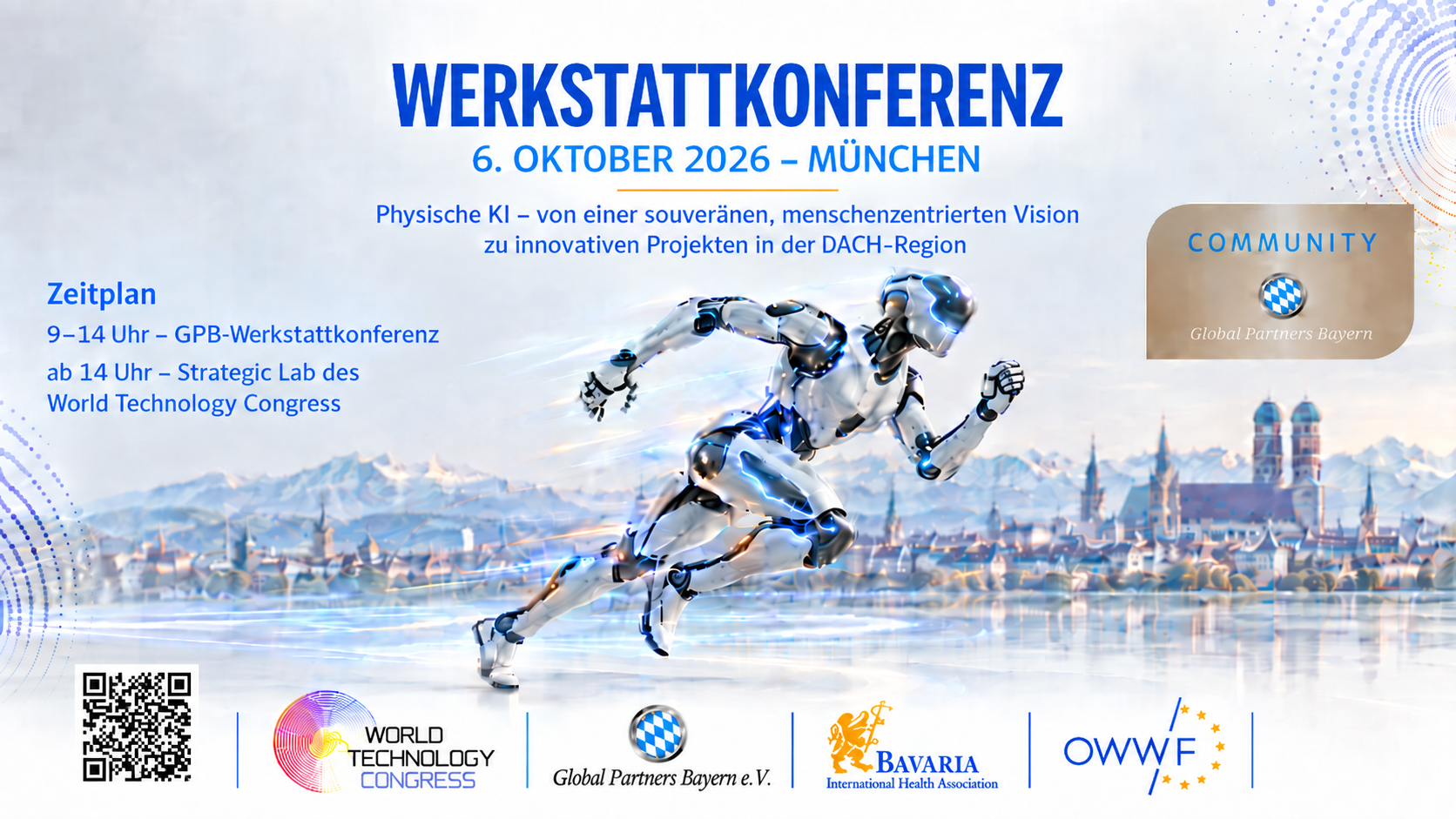
Physical AI: Why Europe’s Sovereignty Is Decided on the Factory Floor
Germany and Europe are investing heavily in technological research and innovation. This has given rise, for example, to strong technology clusters in Bavaria — in artificial intelligence, mobility, robotics, semiconductors, and biotechnology. Our goal must be to translate this research excellence into sustainable economic excellence in a more strategic and consistent manner. An example from the field of robotics illustrates just how quickly this excellence can be lost: the European champions Kuka and ABB Robotics were acquired by foreign owners. But unlike the semiconductor shortage during the pandemic, this sell-off had no political repercussions.
The difference lies in the role of semiconductors as a meta-technology: Without chips, the entire economy grinds to a halt; their production is extremely geographically concentrated, and a single factory costs 10–20 billion euros — which justified the unprecedented response in the form of the EU Chips Act. Physical AI not only inherits these characteristics, it amplifies them: Robots themselves require chips; their motors depend on rare-earth magnets, 90–99% of which are controlled by China; and training the underlying AI models can require investments running into the billions (of euros). The question is whether Europe will act with foresight this time.
Just how quickly the rules of the game can change is already evident across the Atlantic: As of July 28, 2026, the U.S. Federal Communications Commission (FCC) will prohibit new, foreign-manufactured Advanced Robotic Devices from entering the market, regardless of the developers’ country of origin. This example makes it clear: Those who do not actively assert technological sovereignty subject themselves to the dictates of other economic regions. Europe therefore faces a strategic decision on which direction to take: positioning itself between the U.S.’s computing-capacity-based approach and China’s supply-chain-centered policy.
The results of the Lake Como Dialogue show that this concern is not limited to individual cases such as Kuka or ABB: 169 high-level decision-makers from industry, politics, research, and capital markets voted on the key issues of Physical AI governance in this context, with a clear result:
- 82 % prioritize sovereign computing capacity and locally manufactured hardware over global cost efficiency.
- 76 % would be willing to pay a “sovereignty premium” of at least 10% to support a European preference for Physical AI.
- 73 % advocate treating Physical AI spatial data (the “world model”) such as GPS as open, public infrastructure.
A look at capital flows reveals that this preference for sovereignty is not yet a reality: The E6 Initiative — comprising the six largest EU economies (Germany, France, Italy, Spain, Poland, and the Netherlands) — documents a structural capital flight: 70% of later-stage financing for European deep-tech companies comes from abroad, and over 80% of exits are acquisitions by predominantly U.S. buyers. Without domestic growth financing, not only does intellectual property migrate, but so does corporate control.
Wir verwenden Tools, um das Verhalten unserer Benutzer zu analysieren und unsere Website zu optimieren. Sie können dem jederzeit in den Cookie Einstellungen widersprechen.
